Gas Fireplace Won't Light? 7 Things to Check Before You Call
When a gas fireplace won't light, the cause is usually a pilot light that is out, dead batteries, a closed gas valve or a worn thermocouple. Here are seven safe things to check, and when to stop and call.
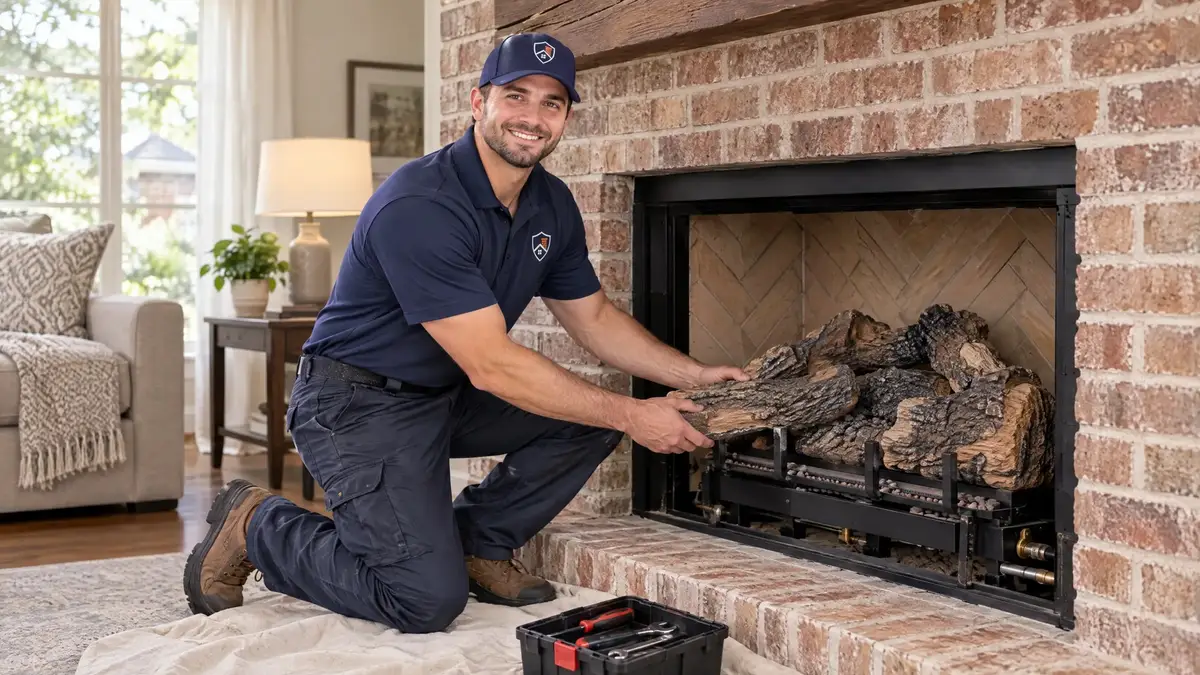
You flip the switch and nothing happens. It is the first cold night of the year in Dallas, and the gas fireplace that worked fine last February just sits there.
In most cases a gas fireplace won’t light for one of a few simple reasons: the pilot light is out, the batteries are dead, the gas is turned off, or a small safety sensor has worn out. Some of these you can check yourself in five minutes.
First, a Safety Rule
If you smell gas, a rotten-egg odor, do not try to light anything. Do not flip switches. Leave the house and call your gas company or 911 from outside.
For everything else, here is a safe troubleshooting list.
1. Is the Gas Turned On?
There is usually a shutoff valve on the gas line near the fireplace, often on the wall or floor beside it, or behind the lower panel. The handle should be in line with the pipe. If someone turned it off for the summer, the fireplace has no gas supply.
Also check that the control knob on the gas valve inside the fireplace is not set to OFF.
2. Is the Pilot Light Lit?
Many gas fireplaces have a standing pilot: a small blue flame that burns all the time. Look under the logs or behind the lower panel. If you do not see a flame, the pilot light is out.
The lighting steps are printed on a label inside the lower panel. In general you turn the knob to the pilot position, hold it in, press the igniter until the pilot flame lights, keep holding the knob for about 30 to 60 seconds, then turn it to ON. Follow the label on your own unit.
If the pilot will not ignite at all, or goes out as soon as you let go of the knob, skip to number 6.
3. Check the Batteries
Remote controls, wall-mounted controls and the receiver box inside the fireplace all run on batteries. So do many electronic ignition systems, which use a battery backup. Replace all of them. Dead batteries are the cheapest fix there is, and one of the most common.
4. Check the Wall Switch
If your fireplace uses a wall switch and the pilot is lit, the switch or its wiring may have failed. The switch carries a very small current that comes from the heat of the pilot flame, so even a little corrosion can stop it.
5. Check the Remote Receiver
Many receiver boxes have a small slide switch marked ON, OFF and REMOTE. If it got bumped to OFF, the remote will do nothing. Set it to REMOTE and try again.
6. The Thermocouple or Thermopile
These are the safety devices of a gas fireplace. They sit in the pilot flame and make a tiny electric current from its heat. That current tells the gas valve it is safe to send gas.
- The thermocouple keeps the pilot lit.
- The thermopile powers the main burner.
When they get dirty or wear out, the valve thinks the pilot is out and shuts off the gas. The signs are a pilot that will not stay lit, or a pilot that is lit while the main burner will not come on. Cleaning the pilot assembly or replacing the sensor is a job for a fireplace technician.
Newer fireplaces with electronic ignition
Not every gas appliance has a standing pilot. Many newer fireplaces use electronic ignition: when you press the remote control, a control module sends a spark to the igniter, lights the pilot and then opens the gas flow to the main burner. If you hear clicking but nothing lights, the igniter, the control module or the gas supply is the likely cause. If you hear nothing at all, start with the batteries.
7. A Dirty Burner or Pilot Tube
A gas fireplace sits unused through a long Dallas summer. Dust, pet hair and even spider webs clog the pilot tube and the burner ports. You may see a weak or flickering pilot flame, flames on only part of the burner, or soot on the logs.
When to Stop and Call a Professional
Stop troubleshooting and call if:
- You smell gas
- The pilot will not light or stay lit after a few tries
- You see soot on the logs or glass
- The flames are yellow and lazy when they used to be blue at the base
- The fireplace makes a booming sound when it ignites
- You are not sure what you are looking at
A gas appliance is not the place to guess. Our gas fireplace repair service call is free in Dallas. We find the problem, give you a written price, and you only pay if you approve the repair.
How to Avoid This Next Year
Have the fireplace serviced once a year, in early fall. A yearly service cleans the pilot and burner, tests the thermocouple and thermopile and checks the venting. It is also worth keeping a carbon monoxide alarm near any gas appliance. The National Fire Protection Association explains why in its guide to carbon monoxide safety.
If your gas logs are old and sooty, new ones may be the better fix. See gas log installation.
Why Dallas Homeowners Trust Dallas Chimney Care
Dallas Chimney Care is an owner-led chimney and fireplace company based in Preston Center. The advice on this blog comes from the same people who do the work on Dallas roofs and fireplaces.
- Owner with 20 years as a chimney technician
- Certified by the Chimney Safety Institute of America (CSIA)
- Insured, with a written price before any work starts
- 5-Year Workmanship Warranty on our work
- A small local Dallas business, not a big chain
Read more about our fireplace services in Dallas or about our team.